





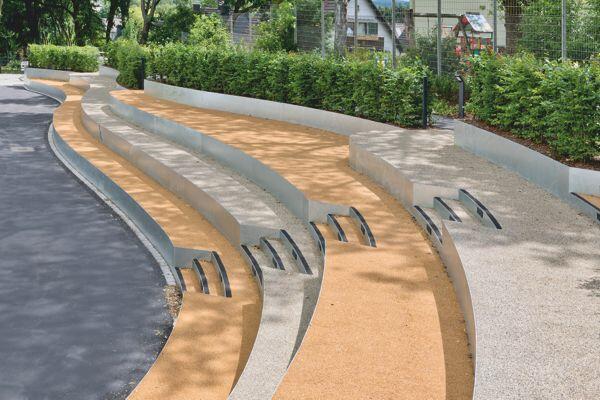
Perfectly shaped planning: curved step landings made of hot-dip galvanized steel in a schoolyard.

During hot-dip galvanizing, the steel base material is immersed in a molten zinc bath (approx. 450°C). After dripping off, a more or less thin zinc layer remains as a coating. This forms both active and passive corrosion protection: the thin layer protects the base metal from moisture (passive) and also acts as a sacrificial anode (active). The steel underneath the zinc coating is protected from corrosion until the zinc is completely consumed. The zinc coating is bright shiny when fresh. Over time, it forms a patina as a result of corrosion, making the appearance darker and more matte.
User information METAL Tender for basic material
Hot-dip galvanized objects can also be coated with paint. To ensure that the paint adheres well, an adhesion improver (primer) is usually applied beforehand. However, whether the adhesion primer was actually applied to the complete hot-dip galvanized surface is difficult to check after paint coating and often only becomes apparent after years due to rust spots. We therefore recommend that garden objects that are to be color-coated be made of the corrosion-resistant base material stainless steel (V2A). This may not be the cheapest option, but it is certainly the most durable.
Corrosion protection by hot-dip galvanizing is resource-saving and sustainable. In direct comparison with other processes, a large amount of CO2is saved.
When it comes to color coating, the question quickly arises as to the best technical process: powder coating or painting? Powder coating is cheaper, more uniform in appearance and more stable in coating. The disadvantage is that defects cannot be repaired (filled) in the base material, and scratches, chipped paint on edges and other defects can hardly be repaired to a high standard on site. Therefore, we recommend painting large-scale, permanently installed garden objects. Painted elements can be filled and scratches can be easily repaired on site. Unfortunately, painting is up to 30% more expensive than powder coating. However, the extra cost is usually worth it, as customer satisfaction is much higher with painted objects in the garden.
Flat sheet metal components are only suitable for hot-dip galvanizing if the aim is pure corrosion protection and no requirements are placed on the appearance of the surface and the tolerances. During hot-dip galvanizing, the process-related heat input always causes distortion and large-scale dents and deformations in flat parts. We therefore advise quality-conscious builders and architects against hot-dip galvanizing and, if necessary, subsequent color coating of sheet metal components. The permissible tolerances in the technically authoritative regulation DIN EN ISO 1461 are much greater than is usually assumed. For this reason, we at Gartenmetall always supply large-format color-coated objects made of the high-quality base material stainless steel, which is then painted. We have made the experience that this is the only way we can meet our own high requirements and the customers' expectations regarding quality and component accuracy.
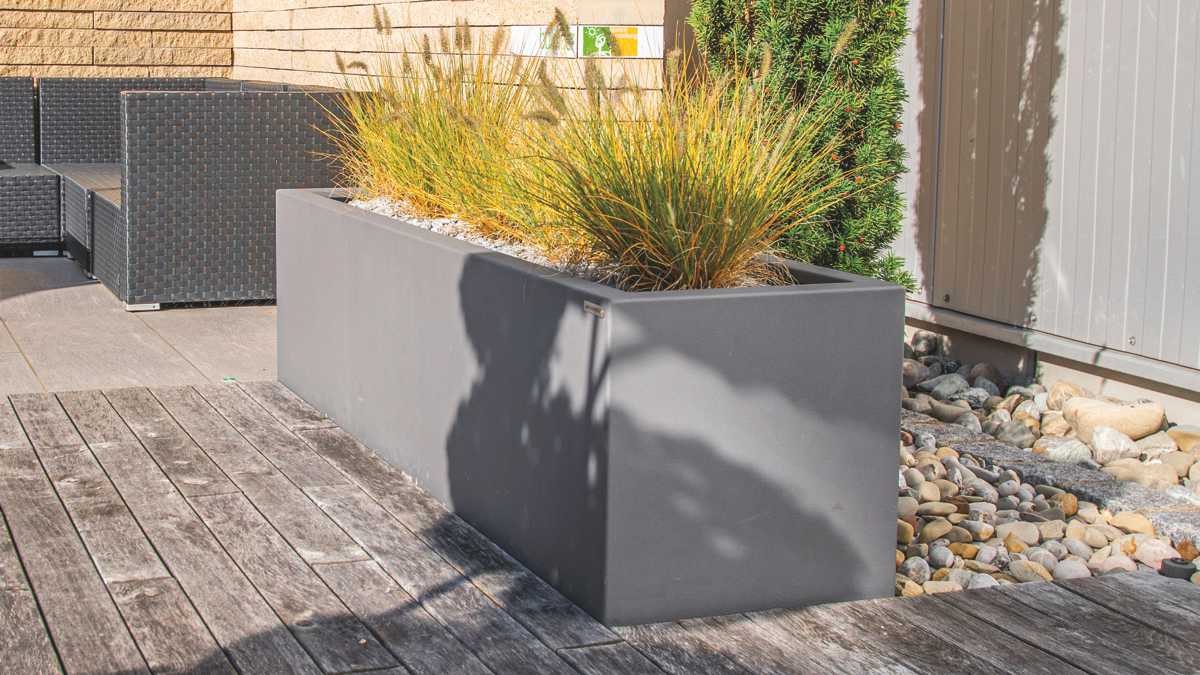
All our hot-dip galvanized garden products are treated in accordance with the requirements of DIN EN ISO 1461. This standard guarantees a minimum coating thickness of 55 μm for material thicknesses between 3 mm and 6 mm, and 70 μm for sheet thicknesses exceeding 6 mm. With these thicknesses, the zinc layer’s passive and active protective properties allow for a service life of over 50 years without the need for maintenance, depending on environmental conditions.
Hot-dip galvanizing protects the underlying steel from corrosion by means of a zinc layer. Given the coating thicknesses we use, a service life of more than 50 years without maintenance is achievable, depending on the specific environmental conditions.
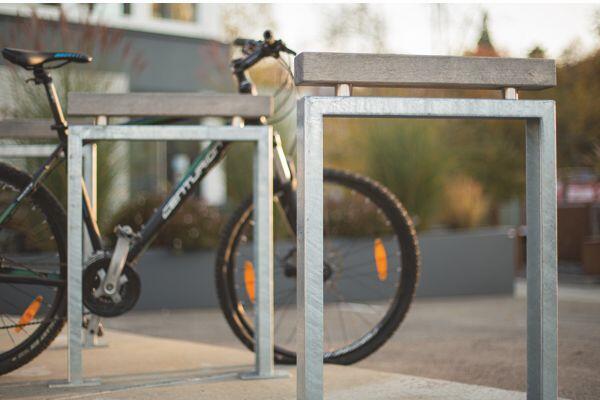
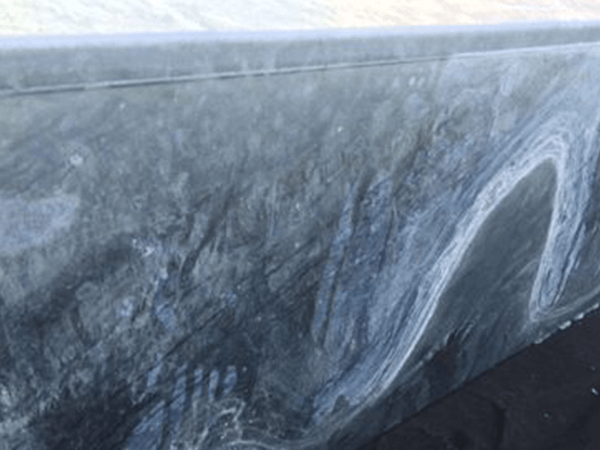
White rust is the name for streaky corrosion on the hot-dip galvanized surface. White rust has no effect on weather resistance, but makes the garden object unsightly. To reduce white rust, many hot-dip galvanizers offer additional protective coatings for the hot-dip galvanized surface. However, this is relatively expensive and is not really necessary if the freshly galvanized objects are properly treated and stored. Therefore, an additional protective coating is not standard and may have to be agreed upon and ordered separately.
"Flat steel rolled with corrosion protection by hot-dip galvanizing (piece galvanizing) according to DIN EN ISO 1461: 2009-10." For load-bearing, hot-dip galvanized metal and steel components in the area regulated by the building authorities, DASt Guideline 022 "Hot-dip galvanizing of load-bearing steel components" must also be applied. There is no need to specify the thickness of the zinc coating separately, as this is regulated in DIN EN ISO 1461.