





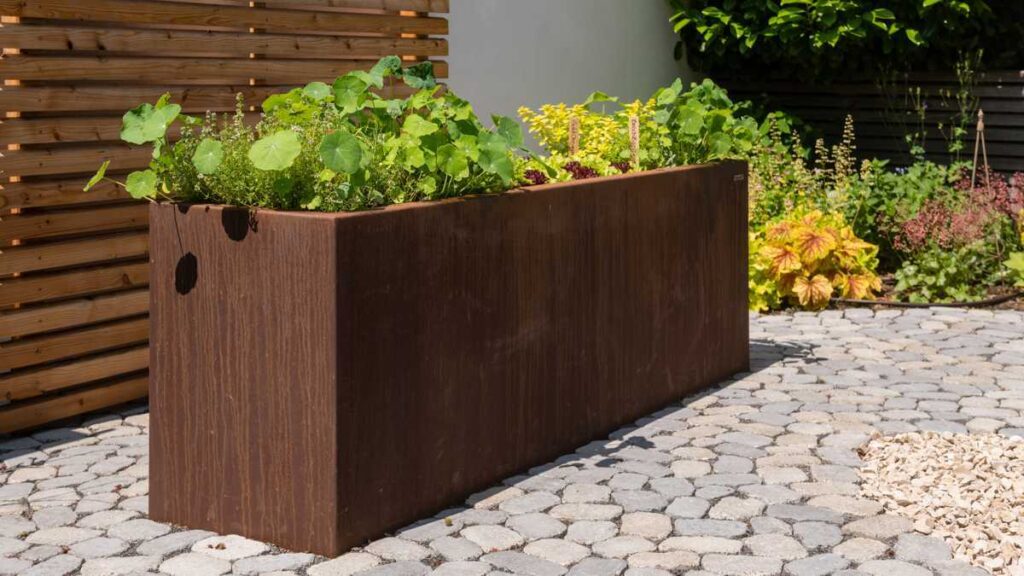
Free-standing planter TERRESTA in private garden, used as a back-saving raised bed.

In Germany, the term "Corten steel"*) refers to a weather-resistant structural steel that develops a continuous protective barrier layer on its surface when exposed to the elements. This layer shields the components from further corrosion and creates a characteristic patina featuring warm, earthy tones. Corten steel is notable for its long service life; it requires no coating to develop its signature patina and can be recycled as metal at the end of its useful life. We use exclusively high-quality steel of grade S355J2W+N (material number 1.8965), which is suitable for bending and—when the correct filler material is used—welding.
*) The name "COR-TEN steel" was formed by combining the first syllable, COR (for corrosion resistance), with the second syllable, TEN (for tensile strength). A patent for COR-TEN steel was filed in the United States in 1932. There is a wide variety of weather-resistant structural steel grades available worldwide.
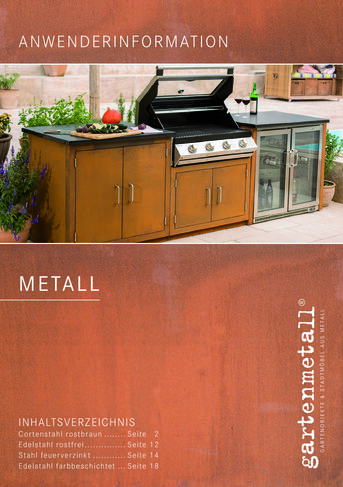
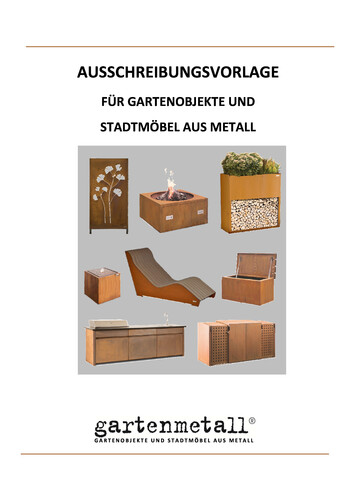
User information METAL Tender for basic material
Corten steel is used in a very wide range of applications: for bridge structures, facades or guard rails. Popular examples are the guardrails on Italian highways. In recent years, corten steel is increasingly used for metal garden objects. The characteristic patina develops a certain life of its own and changes the structures and colors again and again. Last but not least, this property makes corten steel an ideal building material in modern garden and landscape design.
Commercially available Corten steel sheet has a rolled skin on the surface due to the manufacturing process. This consists of a firmly adhering, blue-black layer of very hard iron oxides. The rolled skin is brittle and delays the formation of the rust barrier layer desired in corten steel. In the first few months of weathering, the rolling skin then peels off bit by bit, revealing the "real" bare steel surface. The flaking rust-brown rolling skin is disturbing and unattractive.
We therefore process practically only the particularly high-quality Corten steel, where the rolling skin is pickled off directly after manufacture - i.e. before processing. This is more costly in procurement and production, but you can simply see the high quality of our products through the optimal preliminary products. Not only is the flaking of the mill scale completely eliminated, but the accuracy during laser cutting, bending and welding is also much higher than with simple material with the hard and brittle mill scale.
During the production and processing of the raw steel panels on the surface is not yet formed patina. This develops only through natural weather conditions. The formation of the visually appealing surface begins after 2 to 3 weeks and is completed only after 1.5 to 3 years. Important in the formation of the barrier layer is the alternation between wet and dry weather. If there are surface areas that are not exposed to this weathering, the living patina of rust will not form there. To find out how surface rusting can be accelerated thanks to our SUPER-ROST process, click here: SUPER-ROST process with SUPER-ROST-Pad
It is hard to believe, but the perception can not be fooled: Depending on the weather and environmental influences, a different initial rust coloration develops on the surface - with the same material from an identical production batch. The main factors influencing rust coloration are temperature and relative humidity. Lower temperatures and high humidity result in a darker color. Different colorings after the first rusting become more and more equal with progressive weathering of the objects. This different coloring is therefore not a defect or reason for complaint.
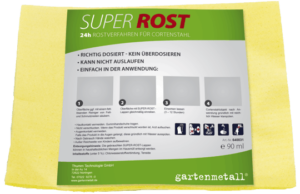
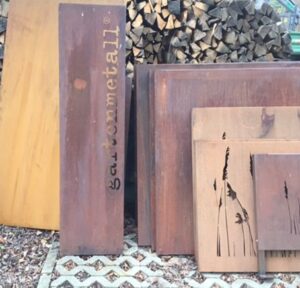
In the absence of air, the still young, rusted surface can turn black, for example, if it is packed for transport with a tight-fitting film or stored incorrectly after delivery. If you do not want to wait for the surface to equalize due to natural weathering, then you can sand the entire surface and re-rust it using the SUPER-ROST process. Learn how to do that in our video:
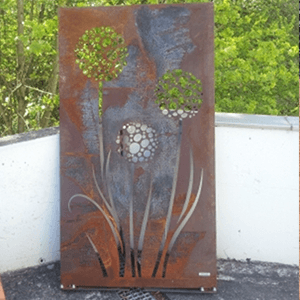
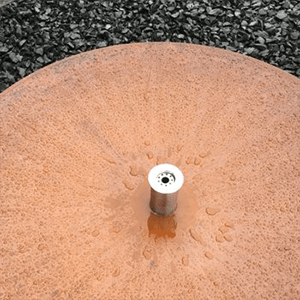
When the raw boards are processed, they are gripped automatically at several production stations with the aid of vacuum suction cups and transported for further processing. From this, imprints can become visible after the first russeting - sometimes less, sometimes very clearly visible.
These imprints, also known as "crop circles" in specialist circles, are caused by the fact that when the SUPER ROST agent is applied, the surface is disturbed by minimal residual particles that adhere to the suction cups. The imprint becomes visible only after the formation of the first red rust patina after 12 h to 24 h. However, with natural weathering, the imprint disappears again. To speed up the process, the affected areas can be mechanically sanded a little and rust again.
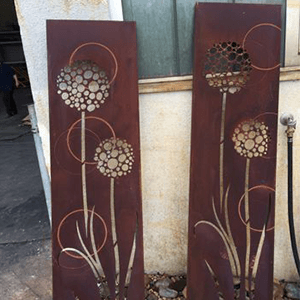
Under the right weather conditions, Corten steel develops a protective rust patina that slows down further corrosion. No additional coating is required to achieve this characteristic finish.
The S355J2W+N grade of Corten steel used by Gartenmetall contains small amounts of alloying elements such as copper and chromium. The material composition and the resulting barrier layer provide the material with its characteristic corrosion resistance.
Thanks to its long service life and the fact that it can be recycled at the end of its use, Corten steel offers tangible material advantages for durable garden features and urban furniture.
Beware of imitations: Decorative items or inexpensive planters are often sold as having a "premium rust look." These are usually made of untreated structural steel; while they may look similar, they can rust through after only a short time. Furthermore, flaking, sharp-edged metal fragments pose a risk to pets, birds, and insects.
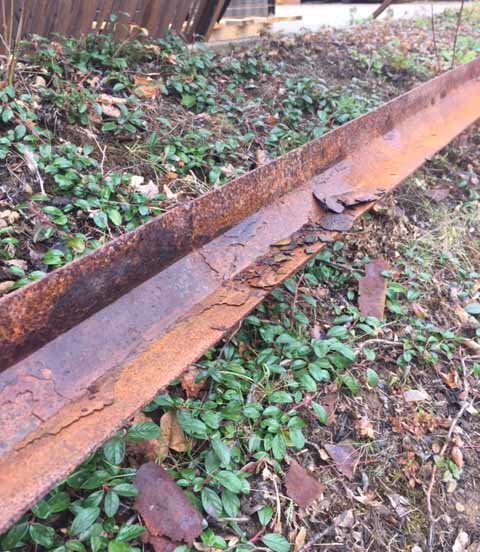
Rusty deposits, generated e.g. by drain water, can be removed more or less successfully with suitable rust solvent. The cleaning success depends mainly on the following factors: Base material, frequency and quality of cleaning and suitability of the cleaning agent.
For acid-resistant floor coverings, cleaners based on phosphoric acid can be used with good success. For light contamination, household remedies such as table salt in combination with citric acid powder (= ascorbic acid) and water are also suitable. In the case of concrete-bound floor coverings, no acidic cleaners may be used, only tannin-based cleaners. Since the surface turns reddish-purple during treatment, it is essential to ensure proper application to avoid consequential damage. In all cases, test the effect of the cleaner on the surface by means of a small sample area!
To reduce rusty deposits and "protect" Corten Steel, there is the possibility of sealing the rusty surface, as soon as the desired rusty surface with the appropriate protective layer has formed. The sealing acts like a classic varnish layer and must be repainted again and again (e.g. annually) as required. For more information on rust sealing, see ROST-PROTECT®.
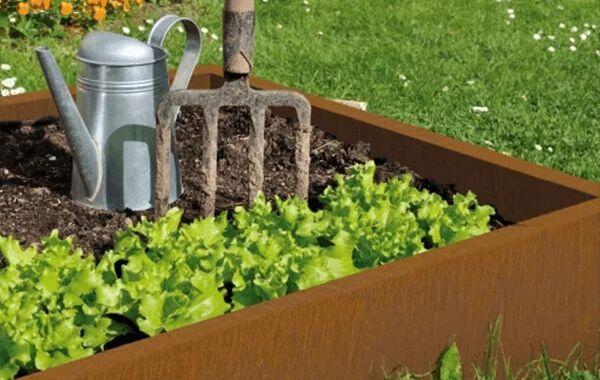
In our experience, slugs often avoid surfaces and borders made of Corten steel. Consequently, using Corten steel for raised beds and planting areas can help reduce the likelihood of slugs crawling over them. The actual effectiveness may depend on specific local conditions.
"Rolled flat steel with corrosion protection by hot-dip galvanizing (piece galvanizing) in accordance with DIN EN ISO 1461: 2009-10." For load-bearing, hot-dip galvanized metal and steel components in the area regulated by the building authorities, DASt Guideline 022 "Hot-dip galvanizing of load-bearing steel components" must also be applied. There is no need to specify the thickness of the zinc coating separately, as this is regulated in DIN EN ISO 1461.
If you need blanks, sheet metal cuttings, blanks or even individual sheets in corten steel - also optically pre-rusted - we can offer these very cost-effectively in many cases, as we buy corten steel in large quantities. Even smaller steel traders and many locksmiths buy their corten steel requirements from us. Ask also for corten steel without rolled skin. This material is produced exclusively for Gartenmetall® by the major steel producers. For a price list and more information, click here: SHEET ADDITIONS