






Street furniture
Design
Designing in urban spaces
In public spaces, built-up areas, transport infrastructure and open spaces often compete with one another. Yet, particularly in urban areas, people need places of retreat in which to recharge. These can be squares that offer a high quality of stay, as well as parks, cemeteries or other public green spaces and open spaces.
A key focus for town planners and local designers must be on ensuring these urban open spaces are protected through specially adapted street furniture designed for public spaces, making them attractive to the public and thereby creating a liveable environment – an urban space, so to speak. We’d be happy to provide you with suggestions and tips on the sustainable design of urban spaces and open areas.


An urban dream for people
Urban spaces must always strike a balance between different interests. On the one hand, this includes recreational areas for the public, such as green spaces with trees, shrubs and flowerbeds. This urban greenery filters the air, provides shade and soothes and delights the eye. To ensure that people can make use of these areas, parks should not skimp on benches and other seating. Special seating and lounging furniture further enhances these green corridors and is generally received with enthusiasm.
It is always important that street furniture for public spaces is robust, weather-resistant and vandal-proof. On the other hand, urban spaces should also provide room for festivals, weekly markets and other events. Here, the focus is more on open spaces that can be used flexibly. If, however, the aim is to avoid creating a monotonous paved area, these urban spaces can be enhanced with mobile tree planters or planting troughs with benches to enhance the area. If necessary, they can be moved by crane or – for smaller items – by forklift truck.
Design ideas for public spaces
Benches are the ideal design element when it comes to increasing the frequency of use and time spent in urban open spaces. They invite people to rest after a stroll through the city, but are also specifically sought out as places to relax. There is a wide variety of models available, which can be installed depending on the spatial context or intended purpose. Straight benches, in particular, invite individual users, couples or small families to take a seat. Thanks to their ergonomic shape, curved benches fit well into parks and urban green spaces. They create inviting rest areas where people are happy to sit. The comfort of benches can be significantly improved if they are fitted with backrests and armrests.& nbsp;
Mobile planters with integrated benches are specially designed for use in public spaces. If necessary, they can be easily moved out of the way using a crane or forklift, thereby reconciling various interests. In recent years, the bicycle has experienced a real boom as a means of transport, partly thanks to e-technology. If town planners wish to prevent bicycles from being parked and locked haphazardly, there should be sufficient bicycle parking spaces and bicycle racks in public spaces. This applies not only to station forecourts, but also to public spaces near town halls, schools and shopping streets.



An intelligent signage system comprising information pillars, display boards and signposts in public spaces provides guidance and information, and is well received by locals and visitors alike. In front of town halls, where new information is constantly being posted, display boards with pull-out panels can be particularly useful. Lighting helps to attract attention and ensures the information remains clearly legible even at night.& nbsp;
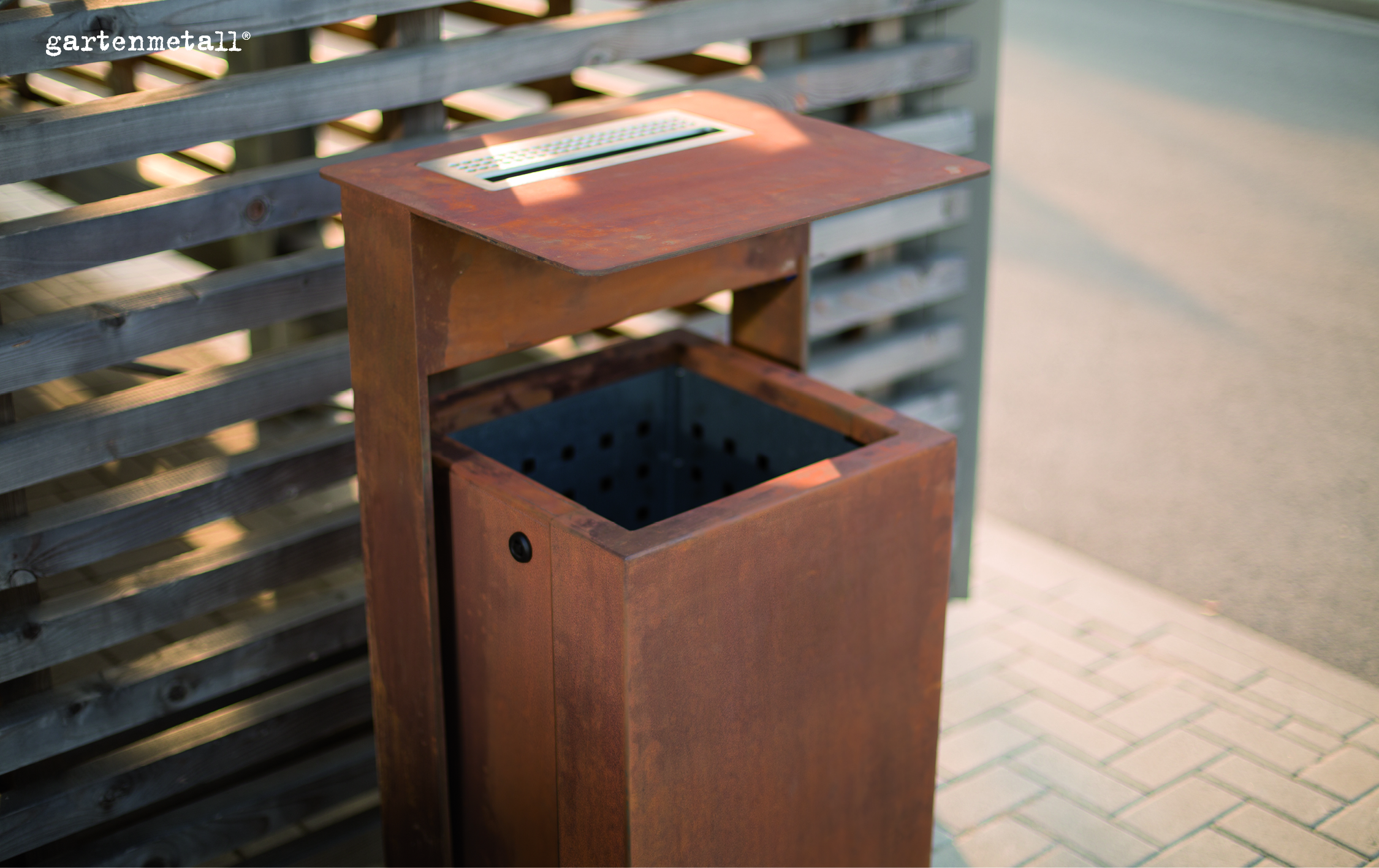
Rubbish bins and ashtrays are more than just a necessary evil in urban spaces. They ensure that city centre areas remain clean and that paper cups, bottles and drink cans do not end up on the ground or in the bushes. These waste bins are available as standalone units or as a combination of waste bin and ashtray. The models are usually space-saving and can either be set in concrete or fixed to a wall. It is important that they are always placed where people gather, for example near seating such as benches and low walls. After all, if the bin is just a few steps away, this significantly increases acceptance. The waste bins themselves must be particularly robust and vandal-proof for use in public urban spaces, and must be easy to empty.
Examples of completed projects
The success of a design can be gauged by its acceptance amongst the local population. Just as one should provide people with paths to walk on, one should also pay attention to their very own expectations and requirements regarding urban spaces and public places.
Redevelopment of the Flacht-Weissach town centre in the district of Böblingen
As part of the refurbishment of the busy district road running through the centre of Flacht, three squares were completely redesigned. The quality of these urban open spaces has improved enormously, and they have been enthusiastically embraced by the local community. Street furniture such as ergonomically curved benches, planters, steps and retaining walls characterise the new look of the historic town centre. The existing old trees were preserved and historic fountains were incorporated into the design.


Redesign of the Bad Krozingen station forecourt
The town of Krozingen in the Rhine Valley showed a bold use of colour when it set about redesigning its station forecourt. Until then, it had been rather dreary and offered little in the way of a pleasant place to spend time for locals and commuters alike. It now features colourful seating areas and brightly coloured planters, transforming it into a real oasis of well-being. The planters are varied and colour-coordinated, planted with ornamental and useful plants as well as small and large trees, and thus also provide shade. To ensure that the town’s gardeners do not have to water so much during hot summers, the planters have been fitted with water-retention mats. These also act as insulation against heat and frost.


Redesign of the village fountain square in Herrenberg-Oberjesingen
The village centre of Herrenberg-Oberjesingen has become a much more pleasant place to spend time. As part of the refurbishment and redesign of the main through-road, the village fountain square was also redesigned. The square has been redesigned to include several long benches, a large planter – which also features a bench – and a stunning water feature, the AQUA CUBUS multi-spring fountain. Existing trees and new plantings provide shade.


